Friday, August 31, 2012

Photos of Garden Restoration

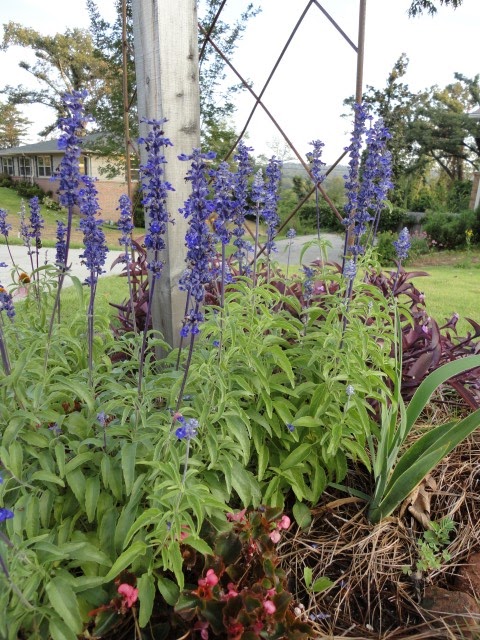
Our new mailbox planting of blue salvia.  I miss the yellow native honeysuckle that used to be there, so hope I can have one climbing up the trellis by next year.
From back to front along the driveway we have Carolina Jessamine on the trellis, swamp sunflowers up and to the right, pineapple sage, lavender, purple coneflowers, lemon balm, and a big stand of confetti lantana.  This area was pretty much intact after the tornado.
We have volunteer morning glories everywhere!  I did not plant new seeds this year.
Our lone sunflower faced our neighbor's fence and back garden to greet the morning sun.It is growing where there used to be a pine tree. All of the area next to the house had trees down on it, and had to all be restored.
This used to be a huge, white bottlebrush buckeye.  I thought it was totally destroyed, but a remnant appeared and bloomed this year.
The little fairy house that was an Easter party project for the children .  It is underneath the Rose of Sharon bushes.
My favorite place in the garden.  St. Francis survived the tornado intact, but there were branches down all over around him, and I didn't know he was OK until all the debris was cleared away.  The crape myrtle was only slightly damaged, and the loropetalum, daylilies and hydrangea made it through OK too.  I have had to move and replace , and find our stones to restore  the pathway. Many of them were buried or moved from the tree cutters and machinery coming through.
A big patch of goldenrod on the left of the arch will bloom this fall. This used to be a pathway to our gate, the park property and path to the school behind us, but it is blocked off now until we start hacking away at the downfall this coming winter, to re-create the path.
Our hydrangea in front of the potting area under the house.  It was damaged as well by branches being thrown over the roof of the house and some of the construction but has recovered nicely.  It does get a lot more sun than it used to.
Everything up to the retaining wall is ours. We used to have trees and shrubs blocking most of the view of our neighbors.  The retaining wall is newly built by our neighbor who had a huge erosion problem on the slope.  He had to have everything regraded and a whole new septic system put in.  His house was much more badly damaged than ours. The magnolia tree on the back of our property (right) was badly mangled in the storm, but I couldn't bear to have it cut down.  It does have some new growth on it and even had some flowers in May.
Another view of St. Francis and our yellow coneflowers and some zinnias.
A new Japanese maple, which is planted in the area where we used to have 2 large oak trees.  Thanks to our friend Bill Gilley from Landscape Workshop who found it for us and his great crew who put in the new sod, the gravel base for what will be a stepping stone sidewalk, and planted the tree.

The oak tree that fell on the house also ripped up a part of the sidewalk.  We plan to have the stones laid this next Spring if possible.
The front of the house has a new bay window.  A big oak tree fell down across the front of the house crushing the roof and breaking out the window.  The plan is to have a window box , or boxes,under the front windows by next spring.
Our beautiful canna lily.  A gift from our friend Anna Lu.
We have an amazing number of zinnias this year.  All re-seeded from the plants last year.
A favorite mix of yellow and purple coneflowers.
Our rebuilt fence and side garden.  The fig tree , which was damaged recovered nicely and gave us a lot of figs this past summer.  Many hellebores popped back up and even some of the Solomon Seal made it through all the compression of the tree removal equipment coming through this area.  The rocks all had to be found and re-stacked, and the Confederate jasmine is newly planted. The previous fence was covered almost completely over by Carolina jessamine, and was covered by yellow blooms in the early spring.  This is outside our kitchen window.

This is how our garden looked at the beginning of the summer, before the extreme heat and several weeks of drought.The yellow coneflowers have gone to seed, and we now have many black-eyed Susans. 


More updated pictures to follow.
Thursday, August 30, 2012

Joe Pye Weed In The Mountains

Black -Eyed Susan   

Rudbeckia hirta


On my drive home from North Carolina I kept to the mountain roads as long as possible , driving on the Gatlinburg bypass to Townsend and enjoying the scenery.  The rocky banks along the roadside, and the riverbanks  in the Smoky Mountains were full of one of my favorite late summer and early fall wildflowers.  Joe Pye weed ( Eupatorium fistulosum) is very tall, growing from 6 to 10 feet tall, the stalks are hollow, the flowers are large puffs of smoky lavender. It is a member of the aster family.  Several of my books say that it is named after a healer, Joe Pye who used the plant in his herbal potions in colonial times to treat typhoid fever.  It has been used to treat kidney stones and urinary tract infections. It likes to grow in moist areas in either full sun of part shade, and  is a good plant to use to attract butterflies to your garden.

I stopped at a  picnic area and park along the Little River for a little lunch break and exercise and walked across the bridge to a trail along the river.  As I walked and really looked carefully, I was excited to see Cardinal flower (Lobelia cardinalis), with its spikes of bright red flowers, growing down near the water. Cardinal flower likes damp soil and filtered light , or afternoon shade. It is another favorite of hummingbirds and blooms in late summer.

As I walked a little further on, there were some small starts of hearts a bursting (Euonymous americanus)  growing under the large trees along the river.  Hearts a Bursting, or strawberry bush is a lovely little shrub that has indistinct flowers in the spring, but has beautiful seed pods that resemble strawberries or hearts and burst open to reveal bright red seeds in the fall.  It also has bright foliage in the fall, and is a plus in any landscape, growing to from 4 to 6 ft. and spreading. It needs to be planted in part shade, and in rich , moist soil. 

There were also lots of asters and black-eyed susans, and Christmas ferns, and many butterflies flitting among the flowers.  The weather was perfect, and it was difficult to walk back over the bridge and get into the car to come home.  I knew that the longer I stayed, the more treasures I would notice.

( I put photos on my cell phone, and as soon as I figure out how to add them to my computer,  I will add them to this posting)


Enjoy the fall flowers!
Susan

Tuesday, August 28, 2012

The North Carolina Arboretum/ Chives

I just returned from a weekend trip to North Carolina last night.  I was there for massage therapy continuing education, but was able to enjoy the North Carolina Arboretum on Sunday evening following my class.  Luckily the gardens are open until 9PM April -October.  The arboretum is a 434 acre public garden located on land within the Pisgah National Forest under a special permit.  It is adjacent to the beautiful Blue Ridge Parkway.

 The arboretum was established in 1986, close to  100 years after Frederick Law Olmstead envisioned it .  there are several miles of hiking trails and pathways through the gardens. Unfortunately for me the Bonsai garden was closed by the time I got there, but I could peek in through the gates at some of it. It is quite spectacular.  There is an education center, and greenhouses and an outdoor events garden with an amphitheater.

I especially enjoyed the quilt garden which is a floral representation of a quilt design.  There is an overlook of the garden so that visitors can enjoy the full view.

There is also a Heritage garden which includes a chimney and stone foundations and a wooden gazebo area and spring.  The plants there include medicinal herbs and plants used in crafts and for  dyes that are traditional in the area.  In addition , there is a stream garden planted primarily with native plants, a holly garden, rhododendron collection,  and a sustainable landscape demonstration garden which is full of native grasses and lovely flowering perennials that serve as a transition area into the forest.

We only had about an hour to spend there, and I wish I could have used the trail system as well as just seen the gardens.  Most of the plants were identifiable and similar to the plants I see here, but there are some that grow better in the mountains and with which I was unfamiliar.  I forgot to take camera and plant books with me, so I plan to go back sometime soon. It was a lovely setting with the mountain ridges visible from part of the gardens. They provide brochures with a guide to the gardens and trails as well as a brochure which features their permanent art exhibit of garden sculptures.

The Biltmore Estate also has a huge garden area and is quite nice to visit, but I wasn't able to make it this trip. I have really enjoyed visiting there in the past, touring both the house and gardens. In addition to these two places, there is also a Botanical Gardens of Asheville which is a ten acre nature preserve filled with native flora of the Southern Appalachians and is next to UNC Ashville.  If you haven't been to Asheville and you like gardens and mountains, please put it on your list of places to go. 


As I am writing this, the first band of rain from Tropical Storm Isaac is coming through our area.  I am glad I went out for my walk and did my garden picking early this morning.  As of now, the storm is heading West of Alabama toward New Orleans , but our South coast is still under a warning .  Tonight and tomorrow we'll have the possibility of strong storms and tornadoes.  We haven't  had any rain here since last week, so we are welcoming the rain, but I hope we don't have any strong wind gusts.

When I went out to the garden this morning I noticed that my chives (Allium schoenoprasum) had started to bloom while I was gone. They have a softly rounded white pom pom of small flowers.  My books say they should bloom in the spring and have lavender to pink flowers.  I must have an odd variety.  I know I purchased them as chives, and that is where my chives have always been, and the leaves still smell like chives.

Chive are grown from bulbs , are in the onion family,  and the thin grass like leaves are used to flavor  cottage cheese , potatoes, gravies, and  egg dishes . The flavor is a mild, onion type flavor. They stay green through the winter in mild climates , but die back in cold winters. They are clump forming and do need dividing every few years.  They can easily be grown in pots on a windowsill as well.   The grassy leaves and pretty flowers look good in flower as well as herb gardens.They are fairly low growing, usually up to a foot.

 Whenever I use chives  in my  cooking,  I think of my father who always loved to have them on baked potatoes , mixed in with the sour cream.

Susan

Monday, August 20, 2012

Mulberry Memories

It looks like we have a volunteer mulberry tree (Morus alba) growing along our back lot line. It is about 5 feet tall .  If it were near our driveway or sidewalk, I  would probably remove it as the berries will stain everything, if it is a female tree, but this is in a mostly harmless place.  The birds will eat the berries, and the driveway and sidewalk may still get stained, but not to the same extent. 

Mulberries are interesting because of  the varying shape of the leaves on the same tree, some have several lobes, some are shaped like mittens, and some are oval. It is a deciduous tree and doesn't have much of a flower in the spring, but the female tree has long, thin, berries.  They grow fairly quickly and can reach 30 to 50 ft high. With spreading branches.

I have wonderful memories of the mulberry tree in my friend's back yard in Wisconsin when I was a child. It was probably a Morus rubra , which has better tasting berries that are colored red.  We had so much fun climbing that tree.  We would sit up there visiting for many hours, and oh, how I loved it when there was fruit.  I would eat those berries until I made myself sick.  None of the other neighborhood kids liked them very much, which meant more for me!

There is a huge mulberry tree in the Birmingham Botanical gardens .  When I walked there this spring I was in heaven while there were berries on the tree.  When I walk at the gardens, it is usually very early morning , so the berries would be my breakfast feast. It was covered up in berries this spring.  I don't know if the warm winter we had had anything to do with that or not. The friend I walk with was very patient while I stopped to eat. I was very grateful for my couple of weeks of mulberry feasts.

Over the weekend we had enough basil for another batch of pesto.  My granddaughters Gates and Arden helped with this batch so that they could learn how to make it.  I put them to work stripping the leaves off the stems.  We had it over pasta , and they got to take some home. The girls were particularly intrigued by the purple variety of basil.  It is one of my favorites as well. 

I have rooted some more, so it is time to put it in pots.  The rosemary I potted last week is still doing well.  I think I will bring some of each in for the winter in pots, even though the rosemary generally is winter hardy this far South.
Susan

Wednesday, August 15, 2012

Compost Morning High/ ginger lilies


 Ginger Lilies


Gardenias having their second bloom
Went out to do chores this morning  and after watering the potted plants, weeding and fertilizing (organic fertilizer) the veggies and wandering around looking at flowers, I decided to move some of the weed and branch compost pile farther back in the garden.  I put it at the lot line with the Vestavia Hills Parks property that adjoins the school.  We will be putting a combination fence and shrub barrier there this fall.  As I took off the top layers to move them to the new location, I was astounded to see how much the underneath layers had decomposed already.  The pile is only about 6 months old.  So much activity with all the various insects and worms that help with the decomposition.  It is fascinating to watch them scurry around.

A few weeks ago I read an article that showed up on Treehugger.com about the chemical composition of the composting material, and how there is a chemical created that gives humans a natural high when they take a good whiff, so I took a few.  I do like the smell of all that humus, and I did have a good day.  Perhaps I should start off every day with a few inhalations near the freshly turned compost.  Maybe it makes the bugs happy , too!

I have one bin of compost that I use for the vegetable gardens, and then a couple of piles of decaying branches and weeds, and other lawn refuse that I use around the shrubs and to fill in holes, etc.

The vegetable garden  compost bin gets layers of vegetable food scraps from the kitchen, shredded newspaper, and grass clippings, and leaves (in the fall) and every once in a while I throw in some spent potting soil.  I turn it every so often to keep it cooking.  I have an open bin of plastic and one of fencing.  Compost bins can also be made of wood, or plastic garbage cans with holes poked in them, and there are lots of commercially made types available in garden catalogs. It is a very beneficial way to add nutrients to your soil.

Many years ago when we lived in Wisconsin I saw a magazine article about building a round garden with a fenced compost bin in the center and then garden beds radiating from that like the spokes of a wheel, with little paths in between for access.  The climbing veggies could be planted at the compost fence and receive the nutrients from the compost as they grew.  I thought it was a grand idea and we had a large empty lot next to the house, so I proceeded to build it.  Unfortunately we moved the next year, but I did love that garden for the one year I had it.  The topography of our present lot, with my garden sandwiched between a retaining wall and the septic field ,  and the slope in the rest of the area does not lend itself to that particular design, but I sure would like to have one made like that  again some day.  Perhaps I can figure out a way to do a half  wheel garden here.

The ginger lilies (Hedychium coronarium) are in full bloom this morning!  They are lovely delicate white blooms with a sweet delicious smell , not gingery at all. My gardenia bushes are also having a little bit of a second bloom, so I think I will make a small arrangement to bring in for my Bible study group when they meet here tomorrow morning. 

Ginger lilies are another good passalong plant.  They are best planted in the fall, like sun to part shade, rich soil, and prefer to have a lot of water. (at least one inch per week) .  I cut them back after the first frost and then add a 4 inch layer  of of mulch for the winter. They only grow well outdoors in zones 7 and 8, so I can't share them with my friends in Northern States. (sorry) They grow to 4 or 5 feet tall, and need dividing every few years as they multiply and spread. They don't start blooming until late August, and isn't it nice to have those fall bloomers to look forward to? 

Go turn your compost pile and take a deep breath!

Susan

Saturday, August 11, 2012

Exuberance!

Exuberance was the word that came to mind this morning when I went into the garden!  After the rain of the last few days almost  everything looks revived and renewed. The tomatoes and cucumbers  are starting to bloom again after having a little rest period.  The okra is going wild with blooms, and the native hibiscus had more blossoms as well.  The crape myrtle is  full of lilac colored  blooms now,  and the new shrubs look much happier. The vines are all happily climbing and creeping everywhere!
My autumn sedum is looking like it will flower soon,and so do the ginger lilies.

I did get yet another little gift this morning.  A small rosebush has appeared where I have the tomatoes this year.  Last fall I dug up 3 knockout roses from the back, next to the vegetable garden, and planted them in the front garden.  This little guy may be a remnant of the rootstock from one of those.  I will add him to my list for the fall grand  relocation  day. I hope we have a very long fall, because my chore list is getting longer and longer.

I did some more weeding and pruning as usual, and did cut back some of  the swamp sunflowers hoping they will still flower in October.  They will grow to between 6 and 8 feet, and there were already some starting to fall over . I just can't stake all of those things, there are too many. My friend Joanie says that she has had good luck with them when she cuts them back by half  in the middle of the summer, so I thought I would try it.  I thinned them out quite a bit in the flower garden behind the fence at the end of the driveway.  They will take over everything very quickly if you don't keep on top of them, another exuberant plant.  They are not a true sunflower, and the only book I could find them listed in is the Alabama Gardener's Guide by Jennifer Greer. She says that they are Heliopsis angustifolius.  They have just a brief mention in her book as one of the perennials. 

The weather section of the paper predicted that the weather tomorrow will be delightful, and if it is anything like this afternoon was, it will be!  This morning was still very damp and we had some gray clouds going over, but then it cleared off and the high humidity was gone.  What a blessing!

Susan


                                                       transplanted rose bush, Knockout Rose

Friday, August 10, 2012

A Gift of Redbuds

We've had a couple of days of storms, bringing much needed rain, but it has remained hot and very humid.  Today the cold front should come through bringing lower humidity and I will feel like getting out to work in the garden again. I have been quite lazy the last couple of days.  The storm yesterday at about 11:00 AM had winds and rain so strong that it knocked over one of my big zinnia plants.  I just pulled it the rest of the way out, because it had planted itself in the herb garden and I need to get that area ready for its fall crop of parsley.
                                                                                                          Eastern Redbud


Tomorrow is Saturday, so I plan on getting about 3 good hours of gardening in before mid-day.  Especially because I am a transplanted Northerner, I just do not do heat well. Of course back at home in Wisconsin they had a killer summer as well.  Maybe I should move to Canada for the summer!

The other morning as I was out in the back tying up the moonflower vine that my friend Jackie had given me, she just happened to call at that very moment. She was so excited because her moonflower vines had flowered the night before, and her family had watched  the process.  I hope that mine flower soon.  The one I cut back is not yet flowering, but it sure is growing.  It is more than halfway to the roof of the porch today. Just as I was writing this, Jackie called again.(we must have a bit of telepathy going on)  She now has 4 moonflower vines blooming, and because the skies have been overcast in the mornings, the blooms are staying until 10:00 AM.  She says this is the first year she has had them, and has never seen them before and thanked me for telling her about them.( I had forgotten that I had)  It feels good to have brought someone so much pleasure, and she has done the same for me, by sharing so many of her plants and her garden expertise.(see moonflowers and morning glories blog for pictures)

As I was out weeding along the fence this week, I found 2 baby Eastern Redbud trees. (Cercis canadensis L.)  This is a wonderful gift, as my 15 foot tree had been destroyed in the tornado.  In March they are one of the first trees to bloom and they have bright pink/purple pea- shaped flowers.  The flowers appear before the heart- shaped leaves which are a beautiful yellow in the Autumn.  They brighten roadsides and wooded areas with early spring beauty.  They lift my heart, and my late mother-in-law, Polly, was especially fond of them so I always think of her when I see them.

The Eastern Redbuds can be planted in full or part sun and grow to about 30' .They have rounded crowns and spreading branches and long flat beanlike pods.  The Audubon Field Guide says that it is also called the Judas Tree, because according to myth, Judas Iscariot hanged himself on the related Cercis siliquastrum. The field guide also says that the flowers can be eaten as a salad, or fried.

I think that in the fall I will transplant one of the babies back over near  where I had the one I lost.
They grow fairly quickly, so maybe it  won't be too many years before I see those beautiful flowers in my garden again!
Susan